

Table of Contents
Introduction
If you are searching for how does Endbugflow software work, the first thing to understand is that publicly available information about the product is limited and somewhat inconsistent. Endbugflow.com currently presents itself primarily as a technical knowledge platform focused on debugging, development concepts, and workflow optimization, rather than providing the kind of detailed product documentation normally expected from a mature commercial software platform.
At the same time, several websites describe Endbugflow software as a bug-management or debugging workflow solution for development teams. Those descriptions commonly associate it with identifying software problems, organizing issues, assigning responsibility, investigating causes, testing fixes, and monitoring applications afterward. However, some of these capabilities are claims made by third-party articles rather than independently verified product documentation.
That distinction matters. This guide explains the Endbugflow software workflow, what can reasonably be established from public information, which features are commonly attributed to it, and what prospective users should verify before treating those claims as confirmed functionality.
What Is Endbugflow Software?
Endbugflow is generally described online in the context of software debugging, bug tracking, and development workflow management. The central idea is straightforward: instead of treating a software problem as an isolated ticket, a structured workflow connects detection, investigation, resolution, testing, and follow-up.
Endbugflow.com itself describes its approach around discovering problems, analyzing and refining possible solutions, and optimizing how development teams apply debugging strategies. Its stated focus includes debugging methods, technical concepts, and digital workflow optimization.
However, there is an important qualification. The public website does not currently provide the level of technical product documentation needed to independently verify every feature attributed to “Endbugflow software” elsewhere. One recent analysis specifically notes uncertainty around the product’s architecture, pricing, API documentation, release history, and some integration claims.
For that reason, it is more accurate to describe Endbugflow as a debugging and workflow concept/platform with limited publicly verifiable product documentation, rather than confidently presenting every third-party feature claim as established fact.
How Does Endbugflow Software Work?
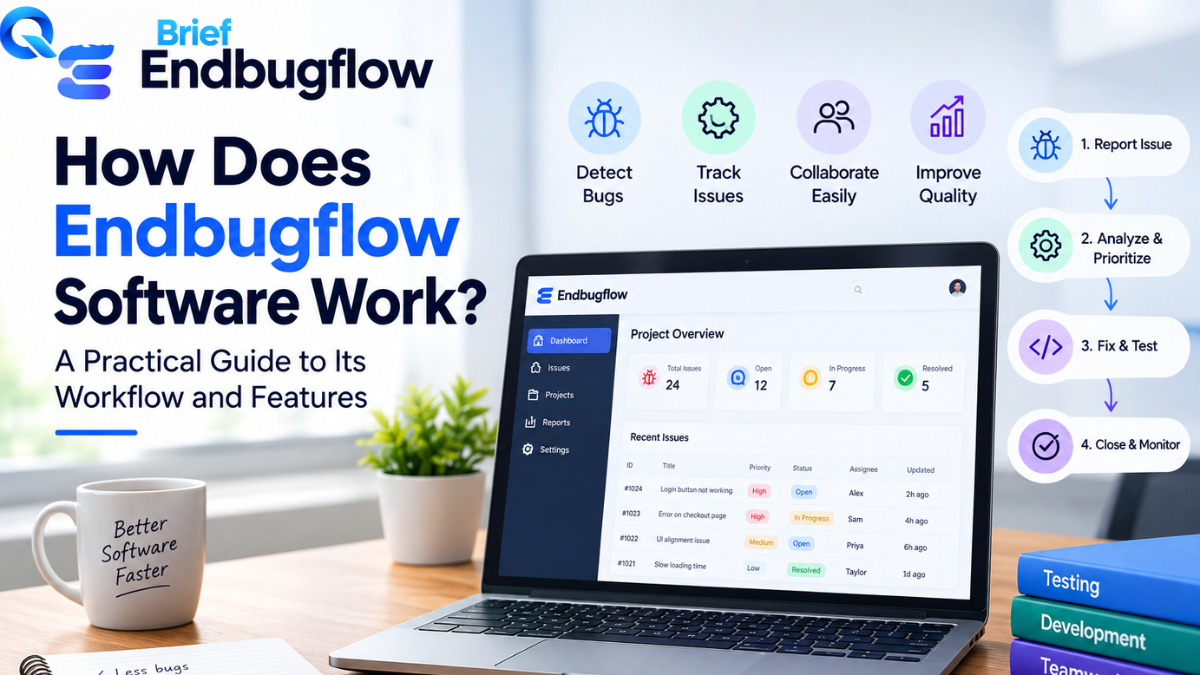
The simplest explanation is that the reported Endbugflow workflow follows the lifecycle of a software problem.
A problem is identified, relevant information is collected, the issue is organized and investigated, someone works on the underlying cause, the proposed solution is tested, and the result is monitored after implementation.
The general model can be represented as:
Problem detection → issue documentation → analysis → prioritization → assignment → development → testing → resolution → monitoring
This resembles the standard lifecycle used by many modern software development and quality-assurance teams. Public descriptions of Endbugflow emphasize similar principles, particularly structured debugging and workflow optimization.
1. A Software Problem Is Identified
The process starts when something does not behave as expected.
A problem could be discovered during software testing, reported by a user, noticed by a developer, or identified through application monitoring. The initial observation might be as simple as a failed login, an application crash, an incorrect calculation, or an API request returning an unexpected result.
A useful debugging system needs more than the statement “the application is broken.” Developers need enough context to reproduce the problem and determine its cause.
2. The Problem Is Recorded
Once an issue has been identified, it needs to become a structured record.
A useful bug report normally contains information such as the affected feature, expected behavior, actual behavior, reproduction information, environment, software version, and supporting evidence.
Some third-party descriptions of Endbugflow claim that it can capture technical context such as logs, stack traces, network activity, device information, and user activity. These capabilities are plausible for a modern debugging platform, but the exact implementation is not sufficiently documented publicly to treat every one of them as confirmed Endbugflow functionality.
3. Issues Are Organized and Prioritized
Not every bug deserves the same level of urgency.
A minor interface problem may be scheduled for a future release, while a payment failure or widespread application crash could require immediate attention.
Bug-management systems therefore commonly use concepts such as severity and priority. Severity describes how seriously a problem affects the software, while priority helps determine how quickly the team should address it.
Third-party material about Endbugflow describes prioritization and issue organization as part of its reported workflow.
4. Developers Investigate the Root Cause
Finding the visible error is only the beginning.
Suppose an application displays an error after a user submits a form. The visible error might actually be caused by a database problem, malformed API request, authentication failure, incorrect application logic, or unexpected input.
Debugging therefore involves tracing the problem backward until the underlying cause can be identified.
Endbugflow’s own public material emphasizes analyzing problems and refining approaches rather than simply recording errors.
5. The Development Team Applies a Fix
Once the cause is understood, developers modify the relevant code or configuration.
A proper workflow keeps this change connected to the original issue. That relationship makes it easier to understand what was changed, why it was changed, and whether the solution actually addressed the reported problem.
This is particularly useful for teams working on large applications where multiple developers may be modifying different parts of the same system.
6. The Fix Is Tested
A developer saying “fixed” does not necessarily mean the issue is actually resolved.
Quality assurance or another developer should normally reproduce the original problem and verify that the corrected version behaves as expected.
Testing also helps identify unintended side effects. A change that fixes one function could accidentally affect another function elsewhere in the application.
7. The Issue Is Closed or Reopened
If testing confirms the fix, the issue can move toward closure.
If the problem remains, it should be reopened and returned to investigation.
This creates a useful feedback loop:
Detect → investigate → fix → test → verify → close
If the problem returns later, the previous information can help the team understand its history.
Endbugflow Workflow at a Glance

The following table summarizes the workflow that is publicly described or reasonably associated with Endbugflow, while distinguishing general software-development practice from product-specific claims.
| Stage | Purpose | Verification level |
| Problem detection | Identify unexpected behavior | Consistent with public descriptions |
| Issue documentation | Record useful technical information | Common workflow practice |
| Analysis | Investigate the cause | Directly aligned with Endbugflow’s stated focus |
| Prioritization | Determine urgency | Commonly attributed to bug-management workflows |
| Assignment | Establish responsibility | Reported by third-party descriptions |
| Development | Implement a correction | Standard development practice |
| Testing | Verify the correction | Standard QA practice |
| Closure | Mark the issue resolved | Standard bug-management practice |
| Monitoring | Check continued stability | Described by some third-party sources, but not fully documented |
The distinction is important because Endbugflow’s public material supports its general debugging and workflow focus, while detailed product capabilities are less clearly documented.
Key Endbugflow Features
When researching Endbugflow software features, readers will encounter several capabilities repeatedly mentioned across third-party descriptions.
Bug and Issue Management
The core concept is organizing software problems so that teams can understand what happened, who is responsible, and what stage the issue has reached.
A centralized issue workflow can be more useful than scattered messages because the problem, discussion, progress, and resolution remain connected.
Debugging Workflows
Endbugflow’s own website places significant emphasis on structured debugging. Its stated approach involves discovering the problem, analyzing it, refining the approach, and applying an optimized solution.
This makes debugging methodology one of the clearest areas associated with the platform.
Technical Context
Some external descriptions claim that Endbugflow can work with information such as stack traces, logs, network activity, and environment details. These types of data can make debugging considerably easier because developers can investigate the circumstances surrounding an error rather than relying solely on a short user report.
Still, these specific capabilities should be confirmed through official product documentation before being treated as guaranteed features.
Workflow Optimization
Workflow optimization is another major theme in Endbugflow’s own public description. The platform says it aims to help developers move from complicated debugging situations toward clearer, more sustainable development processes.
The practical goal is to reduce unnecessary investigation and give developers a repeatable way to approach technical problems.
Collaboration
Bug resolution is rarely a one-person activity on a larger development project. Developers, testers, project managers, and other team members may all contribute.
Several third-party descriptions associate Endbugflow with collaborative issue handling, although the exact collaboration features and interface are not clearly documented in the primary public material.
How to Use Endbugflow
Information about a definitive Endbugflow setup guide is limited, so users should be careful with step-by-step installation instructions found on unrelated websites.
A sensible workflow for evaluating a debugging platform would begin by establishing the project and determining what type of problems the team wants to track. The team would then define its issue workflow, identify who handles investigation and testing, and determine what development information needs to be captured.
The next stage would be connecting the relevant development environment if the product supports the required integration. Public third-party articles have mentioned possible connections with tools such as GitHub, Jira, and Slack, but these claims should be verified directly before relying on them for a production workflow.
After setup, the important test is practical: create a controlled issue, follow its lifecycle, verify how information is recorded, and determine whether the system provides enough context for developers to investigate and resolve the problem.
Endbugflow Automation and Integrations

Automation can make bug management more efficient because software teams deal with repetitive activities throughout the development lifecycle.
For example, a system could potentially create an issue from an error event, notify a responsible team member, update an issue when development work changes, or provide information about recurring problems.
However, Endbugflow automation should be discussed cautiously. Some websites describe automatic detection, categorization, prioritization, and integration with development platforms, but the available public documentation does not establish a complete technical specification for these capabilities.
This is particularly relevant when researching Endbugflow integration. Before connecting development systems, teams should verify exactly what integrations exist, what permissions they require, what information is transferred, and whether the connection is officially supported.
Benefits of a Structured Bug Workflow
The potential Endbugflow software benefits are closely related to the benefits of organized debugging in general.
A structured process gives teams a shared understanding of what is wrong and what needs to happen next. It can also reduce duplicated investigation because developers can see previous reports and decisions.
Another benefit is traceability. When a bug has a documented history, a team can review how it was discovered, investigated, fixed, and tested.
The approach can also support learning. Recurring issues may reveal weaknesses in testing, architecture, documentation, or development processes.
Endbugflow’s own stated philosophy emphasizes clarity, practical debugging, and sustainable workflows, which aligns with these broader benefits.
Endbugflow for Businesses and Development Teams
The concept behind Endbugflow for businesses is most relevant to organizations that build or maintain software.
A small development team may benefit from a centralized workflow simply because team members need to know which problems are active and who is handling them.
Larger organizations have additional challenges. They may have multiple applications, testing environments, development teams, and release cycles. In that environment, consistent issue management becomes more important because a bug can move through several departments before it is resolved.
For Canadian companies, the same principle applies: the tool should be evaluated not simply on its feature list but on whether it fits the organization’s development process, access-control requirements, data-handling policies, and existing technical environment.
What Is Still Unclear About Endbugflow?
This is one of the most important parts of researching the topic.
A number of online articles present Endbugflow as an established software product with detailed capabilities. However, publicly accessible primary documentation does not currently provide enough evidence to independently confirm all of those claims.
For example, available public information does not clearly establish a comprehensive official product manual, complete API documentation, detailed release history, or independently verifiable pricing structure. A recent review specifically highlights these gaps and inconsistencies in publicly available information.
The Endbugflow website itself is clearly active and publishes material about debugging and development workflows, but that should not automatically be interpreted as proof that every feature mentioned by third-party websites exists in a commercial software product.
This distinction is especially important for anyone searching for Endbugflow pricing, download instructions, integrations, or system requirements.
Endbugflow Software Review: What Should You Check?
A responsible Endbugflow software review should separate the concept from the evidence.
The underlying workflow is sensible. Structured bug reporting, prioritization, investigation, testing, and monitoring are established software-development practices.
The uncertainty concerns the exact Endbugflow implementation.
Before adopting the platform, a business should verify its official product identity, documentation, available integrations, security practices, pricing, support arrangements, supported operating systems, and data-handling policies.
This is not an accusation that the software is illegitimate. It is simply good technical due diligence when public product information is incomplete.
Endbugflow Alternatives
If a team is researching Endbugflow alternatives, it should first identify the actual requirement.
Some teams need a basic issue tracker. Others need source-control integration, automated testing, application monitoring, error tracking, or project-management features.
The right alternative therefore depends on the workflow rather than simply the number of features advertised.
A useful comparison should examine issue tracking, developer integrations, automation, reporting, collaboration, security, documentation, pricing, and ease of adoption. Comparing those categories gives a more meaningful result than selecting a tool based on marketing claims alone.
Common Misconceptions About Endbugflow
One misconception is that Endbugflow is clearly documented as a conventional standalone bug-tracking product. The available evidence is more complicated. Endbugflow.com currently describes itself primarily around technical knowledge, debugging strategies, and workflow optimization.
Another misconception is that every feature mentioned in third-party articles has been independently confirmed. That is not the case. Some claims about automated detection, integrations, AI-assisted analysis, and telemetry collection remain insufficiently documented publicly.
A third misconception is that a bug-management workflow automatically fixes software. A workflow system can help organize investigation and resolution, but developers and testers still need to understand the underlying problem and validate the resulting changes.
My Opinion on How Does Endbugflow Software Work
My assessment is that the most useful way to understand how does Endbugflow software work is to separate the well-established debugging methodology from the less clearly documented product-specific claims.
The workflow itself makes sense: identify a problem, collect evidence, analyze the cause, organize the work, implement a solution, test it, and verify the result. Endbugflow’s own public material strongly supports this debugging-and-workflow orientation.
Where I would be cautious is treating third-party descriptions as a definitive technical manual. If someone is considering Endbugflow for a real development project, they should verify the current product documentation, integrations, pricing, security information, and supported environments directly before committing production data or changing an established workflow.
That balanced approach gives readers useful information without turning uncertain online claims into supposed facts.
Frequently Asked Questions About How Does Endbugflow Software Work
What is Endbugflow software?
Endbugflow is publicly associated with software debugging, technical concepts, and development workflow optimization. Some third-party sources describe it more specifically as a bug-management platform, but the exact commercial product capabilities are not comprehensively documented publicly.
How does Endbugflow software work?
The reported workflow centers on identifying software problems, recording relevant information, analyzing issues, organizing and prioritizing work, implementing fixes, testing those fixes, and monitoring the result. Some specific automation and integration claims remain unverified.
Is Endbugflow a bug-tracking system?
It is commonly described online as a bug-tracking or debugging workflow solution. However, Endbugflow’s own website currently emphasizes its role as a technical knowledge and debugging-focused platform, so readers should verify the current product offering before assuming it provides a conventional commercial issue tracker.
Does Endbugflow automatically fix bugs?
There is not enough reliable public documentation to confirm that Endbugflow automatically modifies and fixes application code. Some third-party material discusses automation and intelligent debugging, but those claims should not be treated as proof of autonomous code fixing.
Is Endbugflow suitable for development teams?
The debugging and workflow concepts associated with Endbugflow are relevant to software development teams. Whether the actual platform is suitable depends on its currently supported features, integrations, documentation, security controls, and pricing, all of which should be verified before adoption.
Conclusion
Understanding how does Endbugflow software work requires some caution because the public information surrounding the name is not as comprehensive as the documentation normally available for a mature software product.
The clearest picture is a debugging-oriented workflow built around identifying problems, analyzing technical evidence, organizing development work, applying fixes, testing results, and improving the overall development process. Endbugflow’s own website strongly emphasizes debugging clarity, technical concepts, and workflow optimization.
At the same time, claims about specific automation, integrations, monitoring systems, AI capabilities, pricing, and technical architecture should be independently verified. For anyone researching Endbugflow software in Canada or elsewhere, that distinction between documented information and third-party claims is essential for making an informed decision and more.
