

Table of Contents
Introduction
The search phrase develop oxzep7 software appears to refer to software development, but the available public information about “Oxzep7” is inconsistent. Some online pages describe it as a development framework, while others describe it as a custom software concept or project. I could not find a clearly authoritative public specification, official developer documentation, or established technical standard that confirms Oxzep7 as one specific commercial framework or programming platform.
That distinction matters before development begins. A developer should not assume that Oxzep7 has a particular programming language, SDK, database, API, command-line tool, or architecture unless those details can be verified from the actual project’s documentation.
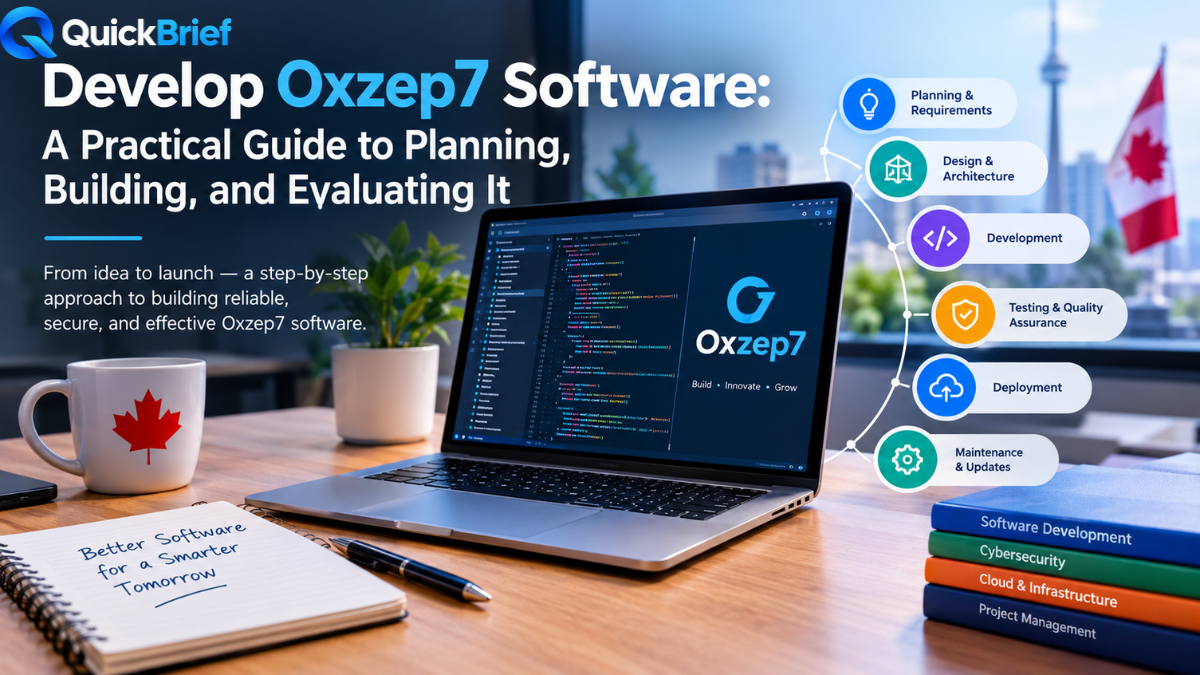
For someone researching Oxzep7 software development, the more useful approach is therefore to examine how a software project under this name could be planned responsibly: defining its purpose, identifying requirements, selecting an appropriate technology stack, designing the architecture, developing an initial version, testing it, deploying it, and maintaining it.
This guide explains that process while separating verifiable information from assumptions. It also highlights what prospective developers should confirm before treating Oxzep7 as a specific technology.
What Does It Mean to Develop Oxzep7 Software?
At its simplest, develop Oxzep7 software means creating a software system associated with the Oxzep7 project or concept. However, because there is no consistently documented public specification, the exact nature of such software cannot be established from the phrase alone.
Several online articles characterize Oxzep7 as a conceptual or emerging software-development topic rather than a standardized framework. One recent guide explicitly notes that public descriptions are inconsistent and recommends verifying the project’s identity and requirements before choosing implementation technologies.
That means the first stage should be clarification rather than coding.
A development team should determine whether “Oxzep7” represents a particular product, an internal application, a framework, a development methodology, or simply the working name of a proposed software system. The answer changes practically everything that follows, including architecture, programming language, infrastructure, testing strategy, and deployment.
Why Project Definition Comes First
A common software-development mistake is beginning with technology instead of the problem.
For example, choosing Python, JavaScript, Java, Flutter, PostgreSQL, or a cloud provider does not automatically define what the application should accomplish. Technology is an implementation decision that should follow functional requirements.
A useful Oxzep7 software project should therefore establish its intended users, business or technical purpose, primary workflows, data requirements, integrations, security requirements, and expected operating environment before development begins.
This approach also prevents a common problem: building features simply because they sound technically impressive rather than because users actually need them.
What Can Be Verified About Oxzep7?
The most important fact for anyone researching Oxzep7 software functionality is that publicly available descriptions do not agree.
Some pages call Oxzep7 a framework or protocol and attribute capabilities such as automation, security, artificial intelligence, and cross-platform development to it. Other sources describe it more cautiously as an emerging or conceptual software-development approach.
There are also websites that present highly specific technical claims, including proprietary SDKs, specialized command-line tools, edge machine learning, and particular cryptographic mechanisms. Those claims should not automatically be treated as established facts simply because they appear online. For example, one page claims that an oxzep7 command-line interface exists and provides commands such as oxzep7 init, while another presents a very different description of the technology.
Without authoritative documentation confirming these capabilities, developers should treat them as unverified claims rather than established Oxzep7 standards.
| Information area | What can currently be established |
| Public identity | Oxzep7 is discussed online under several different descriptions |
| Official technical specification | No consistently authoritative public specification was identified |
| Programming language | No single language can safely be described as the required Oxzep7 language |
| Official SDK | Public claims exist, but an authoritative SDK specification was not verified |
| Architecture | Online descriptions differ considerably |
| Development process | Standard software-engineering practices remain applicable |
| Security requirements | Should be determined from the actual project’s data and threat model |
| Deployment model | Depends on the intended application and verified project requirements |
This uncertainty does not prevent development. It simply means that a responsible developer should define and verify the technical foundation before making specific implementation claims.
How to Develop Oxzep7 Software Step by Step
Define the Purpose and Users
The first stage of the Oxzep7 software development process should be requirements discovery.
Start by identifying the problem the software is supposed to solve. A business application might manage customers, projects, documents, inventory, or internal workflows. A technical application might process data, expose APIs, automate tasks, or provide analytics.
The intended users should also be identified. Administrators, employees, customers, developers, and external partners can require completely different interfaces and permissions.
A concise requirements document can establish the project’s scope before development starts.
Establish Functional Requirements
Functional requirements describe what the software must actually do.
For example, if Oxzep7 is intended as a business platform, requirements could include account management, authentication, dashboards, data entry, search, reporting, notifications, and administrative controls.
If the application is intended for developers, the requirements might instead involve APIs, data processing, automation, integrations, configuration management, and monitoring.
These are examples of possible requirements, not verified Oxzep7 software capabilities.
The distinction is important because a development guide should not turn hypothetical features into claims about an existing product.
Design the User Experience
After requirements are established, the interface can be planned.
A good interface should reflect the user’s workflow rather than the developer’s internal architecture. Navigation should be understandable, important actions should be easy to locate, and error messages should explain what went wrong.
Wireframes can be created before implementation. This allows developers and stakeholders to identify confusing workflows without spending time building the complete interface first.
For web applications, this could mean designing responsive pages. For mobile software, it could mean creating layouts that work across different screen sizes. For desktop applications, keyboard interaction and window behavior may become more important.
Choose the Technology Stack
Technology selection should come after requirements.
There is no verified evidence that one particular programming language is mandatory for every project described as Oxzep7. Therefore, claims that developers must use a specific language should be treated cautiously.
A conventional software project could use Python, Java, JavaScript, TypeScript, Java, C#, Dart, or another appropriate language depending on its requirements.
The same principle applies to databases. PostgreSQL, MySQL, MongoDB, SQLite, or another database may be appropriate depending on the application’s data model.
| Software layer | Possible technologies | Selection consideration |
| Front end | React, Vue, Angular, Flutter or native technologies | Platform and interface requirements |
| Backend | Python, Node.js, Java, C# and others | Performance, ecosystem and team expertise |
| Database | PostgreSQL, MySQL, MongoDB, SQLite | Data structure and workload |
| API | REST, GraphQL or other approaches | Integration requirements |
| Version control | Git | Collaboration and change tracking |
| Testing | Unit, integration and end-to-end tools | Application complexity |
| Hosting | Cloud, VPS or on-premises infrastructure | Security, scale and operational requirements |
These are general software-development options, not officially verified Oxzep7-specific requirements.
Designing the Oxzep7 Software Architecture

Architecture determines how the application’s major components communicate.
A relatively straightforward application might use a frontend, backend, database, and external-service layer. Larger systems may require additional components for authentication, background processing, caching, messaging, analytics, monitoring, and file storage.
Modular Architecture
A modular structure separates different responsibilities.
For example, authentication should not be tightly mixed with unrelated reporting logic. Similarly, database operations should ideally be organized so that changes to one part of the application do not unnecessarily break another.
This makes the system easier to test and maintain.
API Design
APIs allow different software components to communicate.
If Oxzep7 is intended to connect with external applications, APIs may become an important part of the architecture. Authentication, authorization, input validation, rate limiting, error handling, and documentation should be considered from the beginning.
An API should expose only the functionality that clients actually need.
Database Design
Database planning is another fundamental part of application development.
Developers should determine what information needs to be stored, how records relate to each other, which fields require indexes, and what data should be retained or deleted.
Poor database design can create performance and maintenance problems later, even if the application’s interface looks good.
Building an Initial Oxzep7 Software Version
A practical way to approach develop Oxzep7 software is to build a small first version rather than attempting to create every possible feature immediately.
An initial version should demonstrate the core workflow.
Suppose the proposed application is a business management system. The first version might allow a user to sign in, create a record, view that record, update it, and generate a basic report. More advanced automation and integrations could follow after the central workflow is proven.
This approach provides useful feedback without requiring the entire system to be completed first.
Why an MVP Can Help
A minimum viable product, or MVP, is a limited version designed to test the core value of an idea.
An MVP does not mean careless development. Security, data integrity, accessibility, and reliability still matter. It means prioritizing the essential workflow before adding secondary functionality.
This is particularly useful when the underlying Oxzep7 requirements are unclear because the team can validate the project’s direction before committing heavily to a large architecture.
Testing Oxzep7 Software
Testing should happen throughout development rather than only immediately before release.
Unit tests can check individual functions or components. Integration testing can determine whether different parts of the application communicate correctly. End-to-end testing can simulate realistic user workflows.
Security testing is also important when applications process sensitive information.
Performance testing can reveal how the application behaves as traffic, data volume, or concurrent users increase.
A basic testing strategy might therefore cover functionality, integration, security, usability, performance, and deployment.
The exact testing tools should depend on the chosen technology stack rather than on unverified assumptions about Oxzep7.
Security Considerations
Security should be treated as part of the architecture rather than as a final feature.
Authentication should verify user identity, while authorization determines what each authenticated user is permitted to access.
Sensitive information should be protected both in transit and, where appropriate, at rest. Credentials should never be stored as plain text. Application dependencies should also be monitored for known security problems.
Logging is useful for diagnosing failures and investigating suspicious activity, but logs themselves should not unnecessarily expose sensitive information.
If the software operates in Canada or handles Canadian users’ personal information, privacy requirements should also be considered during design. The exact legal obligations depend on the application’s circumstances, the organization operating it, the information involved, and the jurisdictions applicable to the project.
For that reason, privacy compliance should be assessed with appropriate legal or compliance expertise rather than reduced to a generic software feature.
Deployment and Maintenance
After development and testing, the application needs an operational environment.
A web application might be deployed to cloud infrastructure or a server. A desktop application might require an installer and update mechanism. A mobile application needs an appropriate distribution process.
Deployment should include configuration management, backups, monitoring, logging, and rollback procedures.
Maintenance begins immediately after launch.
Software dependencies change. Security vulnerabilities are discovered. Operating systems are updated. User requirements evolve. Bugs appear in situations that were not present during development.
A sustainable Oxzep7 software system therefore needs a maintenance plan rather than treating launch as the end of development.
Common Challenges When Developing Oxzep7 Software
One major challenge is unclear technical documentation. If the name refers to a proprietary or internal system, developers may need access to project-specific specifications before they can implement it correctly.
Another challenge is selecting technologies too early. Developers sometimes choose a stack because it is familiar rather than because it matches the actual requirements.
Integration is another potential difficulty. A system that communicates with payment services, business databases, third-party APIs, identity providers, or other applications needs carefully defined interfaces.
Security can also become complicated as functionality grows. A simple prototype may have only a few users, while a production application may need role-based access, audit logs, backup policies, monitoring, and stronger operational controls.
Finally, scope can become a problem. Adding features faster than the team can test them can make the application difficult to maintain.
Oxzep7 Software Tools: What Should Developers Look For?
Because a verified official Oxzep7 toolchain could not be established from authoritative public documentation, developers should avoid treating random online commands or claimed SDKs as official.
Instead, look for documentation from the actual project owner or organization. Useful documentation should identify supported versions, installation requirements, APIs, configuration, examples, compatibility information, security considerations, and release history.
If the project provides a repository, developers should also check its ownership, release activity, documentation, dependency information, and licensing.
This verification step is more valuable than simply searching for an Oxzep7 development tool and installing the first result.
How to Evaluate Oxzep7 Software Claims
When researching Oxzep7, it helps to separate three categories of information.
Confirmed information should come from authoritative documentation or another strong primary source.
Reported information can be described as something published by a particular website or organization, but should not automatically be presented as established fact.
Unverified claims should remain clearly identified as such or be excluded from the article entirely.
This is especially important because several online pages currently make detailed claims about Oxzep7’s architecture and capabilities while providing little evidence that those claims represent a standardized technology.
For developers, this means documentation quality should be considered a technical requirement in its own right.
Oxzep7 Software Development for Canadian Projects
For a Canadian organization considering an Oxzep7-related project, the development process should begin with the organization’s actual requirements rather than with assumptions about the name.
The project team should establish where information will be stored, who can access it, what personal information is collected, which external services are involved, and what contractual or regulatory requirements apply.
Data residency may also matter depending on the organization and its obligations, but it should not be assumed that Canadian projects universally require Canadian-hosted infrastructure.
Accessibility can also be an important consideration, particularly when software is intended for public-sector or broadly accessible services.
The most appropriate implementation depends on the project’s users, industry, information, operational requirements, and applicable rules.
How to Improve the Oxzep7 Software Development Workflow
A strong workflow is based on short development cycles and continuous verification.
Requirements should be converted into manageable development tasks. Developers should implement and test changes in controlled environments before release. Version control should preserve a clear history of modifications.
Code review can help identify defects and maintain consistency. Automated testing can reduce repetitive manual checking. Monitoring can provide information about how the deployed system behaves.
Documentation should evolve alongside the application rather than being postponed until the end.
These practices are not unique to Oxzep7. They are established principles that can make almost any software project easier to manage.
My Opinion on Develop Oxzep7 Software
My assessment is that the phrase develop oxzep7 software should currently be approached with caution rather than with assumptions about a fixed technology stack.
The strongest practical point is not that Oxzep7 definitely uses a particular programming language, architecture, AI system, database, or cryptographic mechanism. Public sources do not provide enough consistent authoritative evidence to establish those details confidently.
For a developer, that uncertainty actually gives requirements gathering greater importance. Before writing production code, verify what Oxzep7 refers to, identify the authoritative project owner or specification, confirm supported technologies, and determine the actual functionality required.
If the project is a custom software concept rather than a standardized framework, conventional software-engineering methods provide a sensible foundation. Requirements, architecture, testing, security, deployment, and maintenance remain important regardless of the project’s name.
The key lesson is simple: verify the technology before building around it.
Frequently Asked Questions About Develop Oxzep7 Software
What does develop Oxzep7 software mean?
It generally refers to building software associated with a project or concept called Oxzep7. However, publicly available descriptions are inconsistent, so the exact meaning should be confirmed from authoritative project documentation.
Is Oxzep7 an officially documented software framework?
I could not verify a single authoritative public specification establishing Oxzep7 as a standardized framework. Online sources describe it in different ways, so developers should verify the project’s identity before selecting Oxzep7-specific tools or technologies.
What programming language should be used to develop Oxzep7 software?
There is no reliably verified universal programming language for Oxzep7 based on the public information reviewed. The appropriate language should be selected according to the project’s actual requirements and any confirmed official documentation.
What tools are needed for Oxzep7 software development?
The tools depend on what Oxzep7 actually represents. A conventional software project may require a programming language, development environment, version-control system, database, testing tools, deployment infrastructure, and monitoring. Any claimed Oxzep7-specific SDK or CLI should be verified before use.
Can Oxzep7 software be developed for a business?
Yes, if Oxzep7 is being used as the name for a custom business software project. The development team can define appropriate workflows, data structures, user roles, integrations, security controls, and reporting requirements. The exact features should come from the business requirements rather than unsupported assumptions about Oxzep7.
Conclusion
The search for develop oxzep7 software currently leads to a fragmented set of online descriptions rather than one clearly established technical specification. Some sources describe Oxzep7 as a framework or protocol, while others present it as a conceptual or custom software project.
For that reason, the safest development strategy is to verify the project’s identity and documentation before choosing a specific Oxzep7 programming language, SDK, architecture, or command-line tool.
Once the requirements are established, the project can follow a conventional development lifecycle: define the problem, identify users, design the system, choose suitable technologies, build the core functionality, test it thoroughly, deploy it securely, and maintain it over time.
That approach keeps the focus where it belongs: on creating software that has a clearly defined purpose, reliable functionality, appropriate security, and measurable value for its intended users and more.
