

Table of Contents
Introduction
The search term melamine1234 is unusual because it does not correspond to a clearly documented chemical name, established product, recognized organization, or official Canadian program in the authoritative sources reviewed for this guide. That distinction matters. A search phrase can appear online without representing a formally recognized subject, and assuming that every unusual keyword has an established definition can quickly lead to inaccurate information.
The most useful way to understand melamine1234 is therefore to separate the searchable term from the established subject it appears to reference: melamine. Health Canada identifies melamine as a synthetic chemical known chemically as 1,3,5-triazine-2,4,6-triamine, with CAS Registry Number 108-78-1. It is used in the manufacture of resins, laminates, plastics, foams, paints, coatings, adhesives, and other industrial products.
For Canadian readers, melamine is particularly relevant because Health Canada has assessed its potential health effects and established interim maximum levels for melamine and cyanuric acid in certain foods. Canada also regulates products and materials in which melamine can be present.
This guide explains what can and cannot currently be verified about melamine1234, what melamine actually is, where it is used, why safety discussions surrounding it matter, and how Canadian regulations approach the substance.
What Is Melamine1234?
There is currently no reliable evidence in the authoritative sources reviewed for this article that melamine1234 is the official name of a distinct chemical or regulated substance.
The number “1234” may simply be part of a username, search identifier, internal label, website name, account name, product reference, or other online term. Without a reliable source explaining the origin of the complete phrase, assigning a specific meaning to “1234” would be speculation.
The distinction can be summarized as follows:
| Term | What can be established |
| Melamine | A recognized synthetic chemical |
| 1,3,5-Triazine-2,4,6-triamine | Chemical name for melamine |
| CAS 108-78-1 | Registry number associated with melamine |
| Melamine1234 | No authoritative definition identified in the reviewed sources |
| Melamine-formaldehyde resin | An important class of materials made using melamine |
| Melaware | Tableware and kitchen products containing melamine |
Health Canada describes melamine as a substance that does not occur naturally in the environment. Its Canadian chemical assessment covers industrial and consumer uses as well as possible exposure through products, food, water, and dust.
Consequently, readers searching for melamine1234 meaning should be cautious about websites that confidently assign a specific definition to the complete term without showing credible evidence.
Melamine1234 Explained Through the Known Meaning of Melamine
Although the complete term remains unverified, the word “melamine” has a well-established scientific meaning.
Melamine is a nitrogen-rich synthetic chemical. Its chemical identity is 1,3,5-triazine-2,4,6-triamine, and its CAS Registry Number is 108-78-1. It is widely associated with the production of melamine-based resins and related materials.
One of the best-known applications is the production of melamine-formaldehyde resins. These resins can be incorporated into laminates, molded products, adhesives, coatings, and tableware. The characteristics of the resulting material depend on the formulation and manufacturing process rather than on melamine being used as a standalone material in every application.
This explains why the word melamine appears in everyday product descriptions. A kitchen plate, decorative laminate, shelf, coating, or other manufactured item may contain a melamine-based material even though the finished product is substantially different from the original chemical.
For someone searching for melamine1234 information, this distinction is important because “melamine” can refer either to the chemical itself or, informally, to products manufactured using melamine-based resins.
What Is Melamine Used For?
Melamine has a broad range of industrial and commercial applications.
Health Canada reports that melamine is primarily used in the manufacture of melamine-based resins for laminates and plastics. It is also used as a flame retardant in polyurethane foams, paints, and coatings. Other Canadian applications identified by the government include thermally fused melamine paper and shelves, whiteboards, flakeboards, sealants, and inkjet ink.
Melamine-formaldehyde resin is especially important because it can produce durable materials suitable for demanding applications. Decorative laminates, molded products, adhesives, and tableware are examples of areas where melamine-based chemistry has been used.
The Canadian government has also identified melamine in certain food-packaging applications. These include particular coatings and packaging materials, such as some can coatings, coatings on metallic closures, paper used for bread or margarine packaging, and films used for milk packaging.
This does not mean that melamine is intentionally added to food. In fact, Canada does not permit melamine to be used as a food ingredient or additive. The presence of melamine in certain packaging or industrial contexts is a separate issue from deliberate addition to food.
Melamine1234 and Melamine Material: Are They the Same Thing?
There is no evidence that melamine1234 is the official name of a particular melamine material.
A useful way to avoid confusion is to distinguish three concepts. The first is the chemical melamine itself. The second is a manufactured material such as melamine-formaldehyde resin. The third is a consumer product made partly from such materials.
For example, a decorative laminate can contain a melamine-based resin, while a finished piece of furniture may use that laminate as its surface. Calling the entire furniture item “melamine” may be convenient in everyday conversation, but technically the chemical and the finished product are not identical.
The same principle applies to melamine tableware. “Melaware” is a term used for tableware containing melamine. Health Canada specifically includes melamine tableware, dishes, and kitchen utensils among consumer products considered in its assessment.
Therefore, searches such as melamine1234 material, melamine1234 composition, or melamine1234 properties should not automatically be interpreted as evidence that “melamine1234” is a separate material.
Melamine Properties and Composition
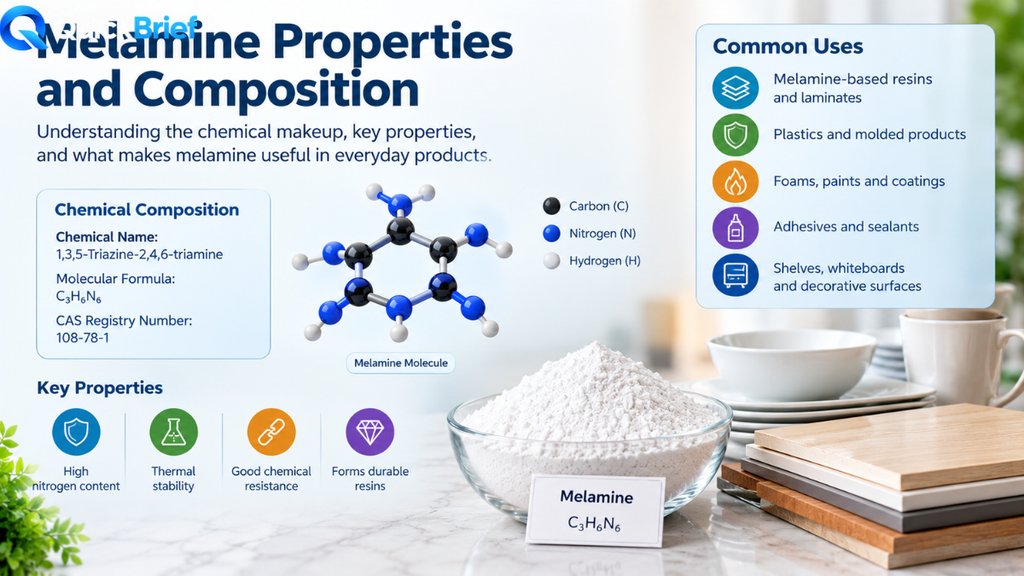
Pure melamine has the molecular formula C3H6N6 and is characterized by a high nitrogen content. Its chemical structure makes it useful in industrial chemistry, particularly when combined with formaldehyde to produce resin systems.
The properties of melamine-based finished products can differ significantly from the properties of pure melamine. Once melamine participates in a resin or polymer system, the resulting material can have characteristics suited to particular manufacturing purposes.
This is why technical discussions should identify exactly what is being discussed. A statement about the chemical properties of melamine should not automatically be applied to a finished laminate, table, shelf, or molded product.
Health Canada’s chemical assessment uses the scientific identity 1,3,5-triazine-2,4,6-triamine and evaluates exposure from multiple sources rather than treating every melamine-containing product as chemically identical.
Melamine Safety in Canada
Safety is one of the most important areas for anyone researching melamine.
Health Canada states that melamine is not an approved food ingredient or additive in Canada. However, trace amounts can occur in food because of environmental and industrial sources. Canada has established interim maximum levels for melamine and cyanuric acid combined in certain foods containing milk and milk-derived ingredients.
For infant formula and sole-source nutrition products, including meal replacement products, the interim maximum level is 0.5 mg/kg for the combined concentration of melamine and cyanuric acid. For other food products containing milk and milk-derived ingredients, the interim maximum level is 2.5 mg/kg.
These values should not be interpreted as permission to add melamine to food. They are regulatory maximum levels intended to manage contamination and protect the food supply.
Health Canada’s broader 2025 assessment also examined exposure from consumer products. The government proposed that certain exposures, including those associated with melamine-containing tableware and some foam-containing products, may pose a risk to human health at the exposure levels considered in the assessment. The assessment and proposed risk-management approach should be distinguished from a claim that every melamine-containing product is automatically dangerous.
Why Is Melamine a Health Concern?
Melamine has received significant scientific and regulatory attention because sufficiently high exposure can affect human health.
Health Canada identifies urinary-system effects and reproductive toxicity among the important health considerations in its assessment. The assessment also discusses carcinogenicity, while noting the evidence and risk assessment framework used to reach its proposed conclusions.
Older Health Canada food-safety information explains that significant exposure can contribute to kidney and bladder stone formation and potentially severe effects on kidney function. Infants and young children can receive greater exposure relative to body weight in certain circumstances, which is one reason food-safety standards pay particular attention to infant products.
The health implications depend on factors such as the amount, duration, route, and source of exposure. It is therefore inaccurate to describe every contact with a melamine-containing object as equivalent to a harmful exposure.
The appropriate question is not simply whether a product contains melamine. It is how the chemical is present, whether it can migrate or become available for exposure, and what the resulting exposure level is.
Melamine in Food and Food Packaging
The relationship between melamine and food is often misunderstood.
Canada does not permit melamine to be deliberately added to food as an ingredient. Nevertheless, very low background levels may occur because of industrial or agricultural sources. Health Canada therefore monitors the issue through food-safety assessment and regulatory controls.
Melamine can also have a role in materials associated with food packaging. Health Canada’s Canadian assessment explains that melamine may be used as a monomer in polymers such as melamine-formaldehyde resins for particular food-packaging applications.
That distinction is crucial. A food-contact material containing a melamine-based polymer is not the same thing as adding free melamine directly to food.
Regulators assess food-contact materials partly by considering whether substances can migrate from the material into food at levels that could create a safety concern.
Melamine Tableware and Kitchen Products
Melamine tableware is another area where Canadian consumers may encounter the substance.
Health Canada identifies melamine tableware, dishes, and kitchen utensils as consumer products that can contribute to exposure. The assessment specifically includes melaware and products sometimes marketed as bamboo-containing tableware.
Consumers should therefore follow manufacturer instructions and product warnings rather than assuming that all tableware made with similar-looking materials has identical properties.
The broader safety question involves how the product is manufactured and used. A finished melamine-based product should not automatically be treated as equivalent to raw melamine powder or another industrial chemical.
Canadian Regulation and Government Oversight
Canada approaches melamine through several regulatory and scientific frameworks.
Health Canada evaluates food-related exposure, while Environment and Climate Change Canada and Health Canada work together on chemical assessments under the Canadian Environmental Protection Act, 1999. The 2025 assessment considered human exposure from consumer products and environmental sources and proposed risk-management measures based on the assessment findings.
The Canadian government has proposed considering melamine for addition to Schedule 1 of CEPA if the proposed assessment conclusion is confirmed. Such a listing would provide a basis for enforceable risk-management actions; it does not automatically mean that every use of the chemical would be prohibited.
This is an important regulatory distinction. Chemical regulation often involves assessment, consultation, risk management, and implementation rather than a simple safe-or-banned classification.
Melamine1234 Search Results and Online Information
People searching for melamine1234 online should be particularly careful about unsupported claims.
A keyword appearing on a website does not establish that it is an official chemical name. Similarly, a product title or user-generated identifier does not prove that a substance has a recognized scientific identity.
For a chemical-related query, reliable identifiers such as the chemical name, CAS Registry Number, government assessment documents, regulatory pages, and recognized scientific references are much more useful than an unexplained keyword.
For melamine, the authoritative Canadian identifier is CAS Registry Number 108-78-1. Health Canada uses this identity in its chemical information.
No comparable authoritative identity was found for the exact term melamine1234 during the research for this article.
Common Misconceptions About Melamine1234
One common misconception is that every unusual term containing “melamine” must be a new type of melamine. There is no evidence supporting that assumption for melamine1234.
Another misconception is that melamine is a food ingredient. Health Canada explicitly states that melamine is not permitted to be added to food in Canada.
A third misconception is that the presence of melamine in a manufactured product automatically means that the product is unsafe. Safety depends on the specific material, exposure pathway, concentration, and conditions of use.
A fourth misconception is that a regulatory maximum level represents a recommended amount of melamine to consume. It does not. The Canadian food limits are controls for contamination and are not authorization to intentionally add melamine to food.
Current Relevance of Melamine in Canada
Melamine remains relevant because it continues to have industrial uses while Canadian authorities evaluate potential exposure and health risks.
The Government of Canada published an updated human-health assessment and revised risk-management scope in January 2025. The assessment considered consumer products such as melaware, foam-containing products, paints, sealants, and cooktop cleaners.
The government’s proposed conclusions should be distinguished from a finalized regulatory conclusion. Health Canada states that the assessment was not yet final on its consumer-facing melamine page and that additional information and public comments form part of the process.
This makes current official Canadian sources more useful than old articles or unexplained online pages when researching the subject.
Melamine1234: What Readers Can Reasonably Conclude
Based on the available authoritative information, melamine1234 should not be presented as a recognized chemical identity without additional evidence.
The established subject is melamine, a synthetic chemical with extensive industrial applications. Its Canadian context includes food-safety controls, consumer-product exposure assessment, food-packaging considerations, and ongoing chemical risk management.
If “melamine1234” is being used as a particular username, website, product code, database entry, or other identifier, its exact meaning would need to come from the source where the term appears. Without that source, creating a detailed biography, product description, company profile, or technical definition would risk inventing information.
This is especially important for SEO content. A page can target an unusual search term while remaining factually responsible by explaining what is known, what is not known, and how the term relates to the established subject.
My Opinion on Melamine1234
My view is that melamine1234 is best treated as an unverified search term rather than as an established scientific or commercial entity unless a reliable source demonstrates otherwise.
The strongest information available concerns melamine itself. Canadian government sources provide substantial documentation about its chemical identity, industrial uses, food-safety controls, consumer exposure, and proposed risk-management measures.
That makes a cautious approach more useful than inventing a meaning for the “1234” portion. Readers searching for the term deserve an explanation that separates verified information from assumptions. In my assessment, that approach is also more trustworthy for Canadian audiences because chemical safety is an area where inaccurate claims can have real consequences.
Frequently Asked Questions About Melamine1234
What does melamine1234 mean?
There is no authoritative source identified in the research for this article that defines melamine1234 as a recognized chemical, product, organization, or technical term. The word “melamine” itself refers to the synthetic chemical 1,3,5-triazine-2,4,6-triamine, but the meaning of “1234” in this particular phrase remains unverified.
Is melamine1234 a type of melamine?
There is currently no reliable evidence establishing melamine1234 as a separate type or grade of melamine. The recognized chemical melamine has the CAS Registry Number 108-78-1. If “melamine1234” refers to a specific commercial product or online identifier, its source would be needed to establish what it represents.
Is melamine allowed in food in Canada?
No. Health Canada states that melamine is not allowed to be deliberately added to food as a food ingredient. Very low levels can nevertheless occur from environmental or industrial sources, which is why Canada maintains interim maximum levels for certain foods.
What is melamine commonly used for?
Melamine is used primarily in manufacturing melamine-based resins, laminates, plastics, and related materials. Canadian government information also identifies applications involving foams, paints, coatings, adhesives, shelves, whiteboards, sealants, and certain packaging materials.
Where can I find reliable information about melamine in Canada?
The most reliable starting points are Health Canada and other Government of Canada resources covering chemical assessments and food safety. These sources provide information about melamine’s identity, uses, exposure, health considerations, and Canadian regulatory measures.
Conclusion
The term melamine1234 does not currently have a clearly verified definition in the authoritative sources reviewed for this article. It should therefore not be described as a distinct chemical, product, company, or technical standard without additional evidence.
The established subject, melamine, is a synthetic chemical used in numerous industrial applications, particularly melamine-based resins, laminates, plastics, foams, paints, coatings, and related materials. In Canada, Health Canada and other federal authorities have examined its potential exposure and health effects, while food-safety controls limit melamine contamination in specified food categories.
For anyone researching melamine1234, the safest approach is to distinguish the unexplained search term from the documented science surrounding melamine. That keeps the information useful while avoiding unsupported definitions or claims and more.
