

Table of Contents
Introduction
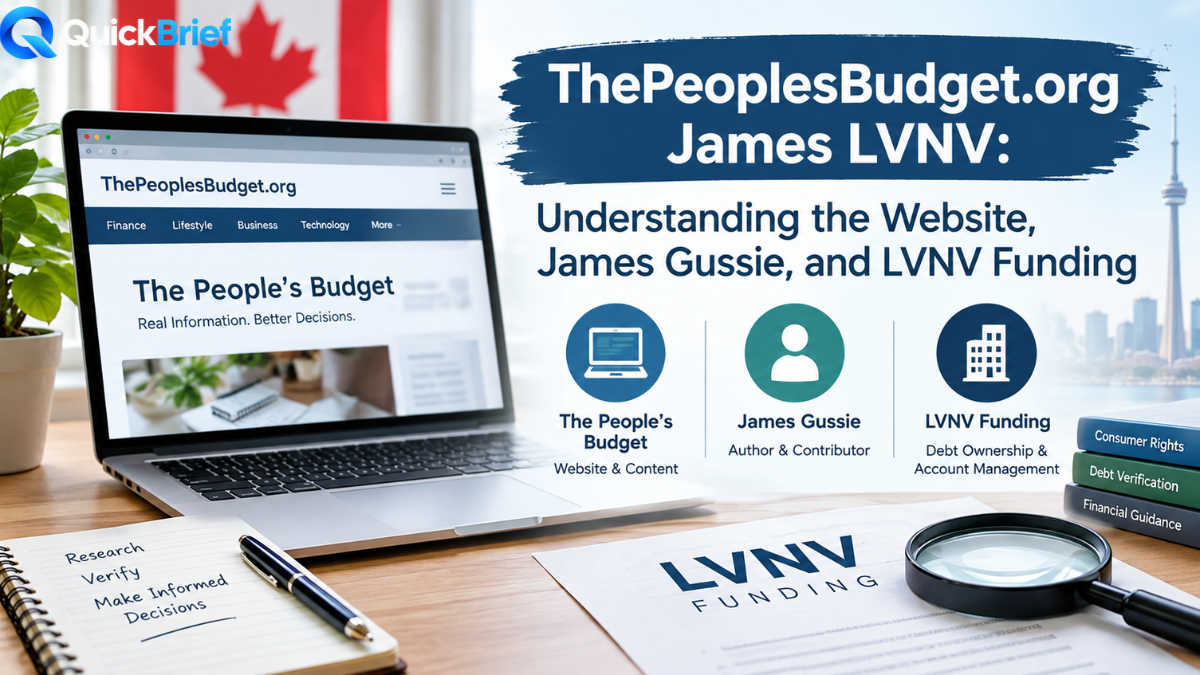
The search phrase “thepeoplesbudget.org james lvnv” brings together three terms that can be confusing when viewed without context: ThePeoplesBudget.org, James, and LVNV Funding. Search results can make these terms appear to represent a single organization or financial service, but the available evidence points to a more specific connection.
ThePeoplesBudget.org has published material about LVNV Funding, and its website identifies James Gussie as an author on its content. A search result for the site shows James Gussie credited on articles published under ThePeoplesBudget.org, including an article concerning LVNV Funding.
LVNV Funding is a separate financial entity. Its current official website explains that it may become the owner of a consumer debt after an account is transferred or sold and says that it outsources management of its portfolio to Resurgent Capital Services.
For readers researching thepeoplesbudget.org james lvnv, the most useful approach is therefore to separate the website and author information from the current information provided by LVNV Funding and official consumer-protection sources.
This article explains that connection, what the available evidence establishes, why LVNV Funding may appear in consumer records, and what readers should understand when researching debt-collection information online.
What Does ThePeoplesBudget.org James LVNV Mean?
The phrase thepeoplesbudget.org james lvnv appears to combine the name of a website, a person’s first name, and the name of a financial company.
The available evidence suggests that James refers to James Gussie, who is credited as an author on ThePeoplesBudget.org. One indexed article on the website lists James Gussie and discusses a topic involving Marvel’s Eternals, demonstrating that his name was used as an author identity on the site.
Separate search results identify a ThePeoplesBudget.org article concerning LVNV Funding and describe James Gussie as its author. Because the original page was not returned directly by the site’s current search index during this research, details about its publication history should be treated as information reported by indexed search results rather than independently reconstructed.
The important distinction is that the available evidence does not establish that “James LVNV” is the name of a company or that James Gussie works for LVNV Funding.
| Search term | What the available evidence indicates |
| ThePeoplesBudget.org | A website that has published articles under the James Gussie byline |
| James | Associated in indexed results with author James Gussie |
| LVNV | Refers to LVNV Funding in the relevant financial context |
| James LVNV | A search combination rather than an established company name |
This distinction is particularly important for financial searches because the appearance of two names together in a search result does not by itself establish employment, ownership, partnership, or endorsement.
Who Is James Gussie in the ThePeoplesBudget.org Context?
The available indexed evidence identifies James Gussie as an author associated with ThePeoplesBudget.org.
For example, a ThePeoplesBudget.org article indexed by search engines lists James Gussie directly beneath the article title.
That provides evidence for an editorial connection between James Gussie and the website. It does not, by itself, establish a professional relationship between James Gussie and LVNV Funding.
This is an important point when researching James LVNV or James LVNV financial information. A person’s name appearing in an article about a company does not mean the person represents that company.
The same principle applies more broadly to online research. An author can write about a company without being employed by it, and a website can discuss a financial organization without being affiliated with that organization.
Therefore, readers should distinguish between authorship, company ownership, employment, and financial relationships rather than treating them as interchangeable.
What Is LVNV Funding?
LVNV Funding is a company involved in the ownership of certain consumer debt accounts.
According to LVNV Funding’s current official website, an account can have a new owner, with LVNV Funding becoming the owner. The company states that it outsources management of its portfolio to Resurgent Capital Services, which it describes as a licensed third-party debt collector specializing in managing these consumer assets.
This arrangement explains why consumers may encounter more than one company name when researching a particular account.
The original creditor is generally the business that originally provided credit or a loan. A debt buyer can subsequently acquire an account, while another company may handle servicing or collection activity. The Consumer Financial Protection Bureau explains that an original creditor may sell an account to another company and that a debt collector may be a third party contracted to collect or an entity that purchased the account.
Why Can Different Company Names Appear?
Debt ownership and debt servicing are not necessarily the same function.
LVNV Funding states that it outsources management of its accounts to Resurgent Capital Services. Resurgent may contact consumers directly or use collection-agency partner.
This means that someone researching James LVNV budget or thepeoplesbudget.org information should not automatically assume that every company name connected with a debt represents a separate debt.
| Term | General meaning |
| Original creditor | The company that originally extended credit or provided the account |
| Debt buyer | A company that purchases certain debt accounts |
| Account owner | The entity that currently owns the relevant account |
| Servicer | A company managing an account on behalf of its owner |
| Debt collector | An entity engaged in collecting a qualifying consumer debt |
The exact circumstances of an individual account can differ, so general descriptions should not be treated as proof about a particular person’s financial records.
How ThePeoplesBudget.org Relates to the LVNV Search

The relationship between The People’s Budget website and LVNV Funding appears to be primarily informational.
Search-indexed material indicates that ThePeoplesBudget.org published an article about LVNV Funding and credited James Gussie as its author. Other indexed pages from the same site also show James Gussie publishing under the website’s name.
That makes the search phrase easier to understand.
Someone searching thepeoplesbudget.org James LVNV may have encountered the website’s article and remembered the author’s first name alongside the subject of the article. Search engines can then connect those terms even though they do not form the name of a single organization.
This is an example of why search keywords should not be interpreted literally without checking the underlying sources.
How Debt Ownership Can Change
Understanding debt ownership provides useful context for searches involving LVNV Funding.
The Consumer Financial Protection Bureau explains that an original creditor can sell a credit account to another company. The resulting debt may therefore appear under a company name that the consumer does not recognize from the original account.
LVNV Funding’s own website describes this situation in similar terms, stating that an account may have a new owner and that LVNV Funding can become that owner.
A simplified example is:
| Stage | Possible development |
| Original account | A consumer obtains credit from an original creditor |
| Missed payments | The account becomes delinquent |
| Account transfer | The account may later be sold or transferred |
| New ownership | Another company becomes the account owner |
| Servicing | A separate company may manage communications |
| Resolution | The account may eventually be resolved according to its circumstances |
This is a general explanation rather than a description of any particular person’s account.
The specific account history is what determines whether a particular claim is accurate.
What Information Should Be Verified?
People researching thepeoplesbudget.org James LVNV may be doing so because they encountered LVNV Funding in a letter, credit-related record, or other communication.
For U.S. consumers covered by the applicable federal debt-collection rules, the Consumer Financial Protection Bureau explains that debt collectors generally must provide validation information about the debt. This information can include the creditor’s name, the amount of the debt, account information, and information about how to dispute the debt.
The CFPB also advises consumers to verify the debt and the identity of the collector before sharing sensitive financial information.
This matters because a legitimate company name can still be misused by someone attempting to impersonate that company.
Why Verification Matters
A search result is not sufficient evidence that a particular debt belongs to a particular person.
Relevant information can include the name of the alleged creditor, the claimed balance, account information, and the identity and contact information of the collector. The CFPB says validation information is intended to help consumers determine whether a debt is theirs and, if necessary, dispute it.
Readers should also distinguish between general online information and documents associated with their specific situation.
An article about LVNV Funding cannot independently confirm whether an individual account is valid.
LVNV Funding and Resurgent Capital Services
One of the most important pieces of current information for anyone researching James LVNV financial information is the relationship between LVNV Funding and Resurgent Capital Services.
LVNV Funding’s official website states that it outsources management of its account portfolio to Resurgent Capital Services. It further says that Resurgent may contact consumers directly or work with collection-agency partners.
This explains why the names LVNV Funding and Resurgent Capital Services can appear together.
It also demonstrates why readers should identify the role each organization is claiming in a communication rather than assuming that every organization mentioned is the original creditor.
The distinction can be summarized as follows:
| Organization or term | Role described by available sources |
| LVNV Funding | Current owner of certain consumer accounts |
| Resurgent Capital Services | Company LVNV says manages its account portfolio |
| Original creditor | Business that originally extended the credit |
| Collection partner | A company that may assist with collection activity |
The actual relationship applicable to a particular account should be confirmed through the relevant account documentation.
Is LVNV Funding a Real Company?

LVNV Funding maintains an official website that identifies LVNV Funding and explains its account-ownership model. The site also identifies Resurgent Capital Services as the company managing its portfolio.
That establishes the existence of the organization described on the official website.
However, there is a second question that should not be overlooked: whether a particular communication genuinely comes from the organization it claims to represent.
The CFPB’s current guidance explains that legitimate debt collectors should be able to provide identifying information and details about the debt. It also identifies refusal to provide basic information, threats, and requests for sensitive information before verification as potential warning signs.
Consequently, company legitimacy and communication authenticity are two different questions.
A real company can exist while someone else falsely claims to represent it.
Consumer Rights and Debt Validation
For U.S. consumers covered by the federal Debt Collection Rule, validation information plays an important role.
The CFPB explains that a debt collector generally must provide required validation information during the initial communication or within five days afterward, subject to the applicable rules.
The information is designed to help consumers identify the debt and understand their response options.
If a consumer disputes a debt in writing within the applicable validation period, the CFPB explains that the collector generally must pause collection activity on the disputed amount until it provides the required verification.
These rules are U.S.-specific. That qualification is particularly important for a Canadian audience. Canadian consumer-protection and debt-collection rules are not identical to U.S. federal rules, and provincial or territorial requirements can also matter.
Therefore, readers in Canada should not automatically assume that U.S. CFPB rules apply to their own situation.
Why Canadian Readers Should Be Careful With U.S. Debt Information
The target audience for this article is Canadian, but the LVNV Funding information found in official sources is strongly connected to the U.S. debt-collection system.
That means Canadian readers should pay attention to jurisdiction.
A U.S. consumer may encounter rules under the Fair Debt Collection Practices Act and the CFPB’s Debt Collection Rule, while a Canadian consumer may instead need to consider applicable federal and provincial or territorial laws.
The underlying research principle remains useful across jurisdictions: identify the company, determine the claimed debt, preserve relevant documents, and verify information through authoritative sources.
But legal rights and deadlines should not be assumed to be identical across countries.
For a significant dispute or legal matter, jurisdiction-specific professional advice is more appropriate than relying on a general blog article.
How to Research ThePeoplesBudget.org James LVNV
Researching thepeoplesbudget.org James LVNV effectively requires separating historical website content from current primary-source information.
ThePeoplesBudget.org material can help explain why James Gussie’s name appears alongside the LVNV topic. The official LVNV Funding website is more appropriate for understanding LVNV’s current description of its business relationship with Resurgent Capital Services. The CFPB is a stronger source for current U.S. federal debt-collection rules and consumer guidance.
This source hierarchy is important because websites can remain online long after information has become outdated.
A useful research process is therefore based on source purpose rather than simply choosing whichever page appears first in search results.
| Source | Most useful for |
| ThePeoplesBudget.org | Understanding the site’s published material and author connection |
| LVNV Funding | Current company information about account ownership |
| Resurgent Capital Services | Information concerning account management |
| CFPB | U.S. federal consumer guidance and debt-collection rules |
| Government or regulator sources | Applicable legal and regulatory information |
Common Misunderstandings About James LVNV
Several misunderstandings can arise from the phrase James LVNV.
The first is the assumption that James LVNV is a company. The available evidence does not establish that.
The second is the assumption that James Gussie is an LVNV Funding employee. The evidence located for this article establishes an author connection with ThePeoplesBudget.org, but does not establish employment with LVNV Funding.
The third is the assumption that seeing LVNV Funding on a document means the company was the original creditor. LVNV’s own explanation concerns accounts for which it has become the new owner, while the CFPB explains that original creditors may sell accounts to other companies.
The fourth is assuming that a real company’s name proves that a particular message is authentic. The CFPB specifically recommends verifying both the debt and the identity of the collector.
Keeping these distinctions clear makes the search much easier to understand.
My Opinion on ThePeoplesBudget.org James LVNV
The most useful way to interpret thepeoplesbudget.org James LVNV is as a search phrase that brings together website authorship and a financial topic, rather than assuming it identifies one organization.
The available evidence supports an association between James Gussie and published content on ThePeoplesBudget.org, while current official information from LVNV Funding separately describes LVNV as an owner of certain consumer accounts and identifies Resurgent Capital Services as its portfolio manager.
That distinction is valuable because financial searches can easily become confusing when names from different sources appear together.
A careful reader should give greater weight to primary sources for current company information and government or regulatory sources for legal and consumer-protection questions.
The result is a clearer picture without making assumptions about relationships that the available evidence does not establish.
Frequently Asked Questions About ThePeoplesBudget.org James LVNV
What is thepeoplesbudget.org James LVNV?
The phrase appears to combine ThePeoplesBudget.org, author James Gussie, and the subject of LVNV Funding. Available indexed material connects James Gussie with articles published on ThePeoplesBudget.org, including material concerning LVNV Funding.
Who is James associated with ThePeoplesBudget.org?
Available indexed pages identify James Gussie as an author on ThePeoplesBudget.org. This establishes an editorial connection with the website but does not establish that he is an employee or representative of LVNV Funding.
What is LVNV Funding?
LVNV Funding describes itself as the owner of certain consumer accounts. Its official website states that it outsources management of its account portfolio to Resurgent Capital Services.
Why might LVNV Funding and Resurgent Capital Services appear together?
LVNV Funding states that Resurgent Capital Services manages its portfolio and may contact consumers directly or use collection-agency partners. This is why the two names can appear in connection with the same account.
What should someone do when researching an unfamiliar debt?
For U.S. consumers covered by the applicable federal rules, the CFPB recommends verifying the debt and collector before sharing sensitive financial information and reviewing the validation information provided about the debt. Canadian readers should also check the laws and consumer-protection rules applicable to their province or territory.
Conclusion
The search phrase thepeoplesbudget.org James LVNV is easier to understand once its components are separated.
ThePeoplesBudget.org has published articles under the name James Gussie, and indexed material connects his authorship with content concerning LVNV Funding. That does not establish that James Gussie is an LVNV Funding employee or that “James LVNV” is a separate company.
LVNV Funding is a distinct financial entity. Its current website says that LVNV can become the owner of consumer accounts and that it outsources management of its portfolio to Resurgent Capital Services.
For consumers researching an unfamiliar debt, the most important distinction is between general online information and account-specific documentation. U.S. federal guidance provides rules concerning validation information and consumer rights, while Canadian readers should consider the laws applicable to their own jurisdiction.
Overall, the available evidence supports treating thepeoplesbudget.org James LVNV as a search phrase connecting website content, an author, and a financial subject—not as evidence of a single company or confirmed business relationship and more.
